
Digital Collections Bern – Making Digital Collections Visible
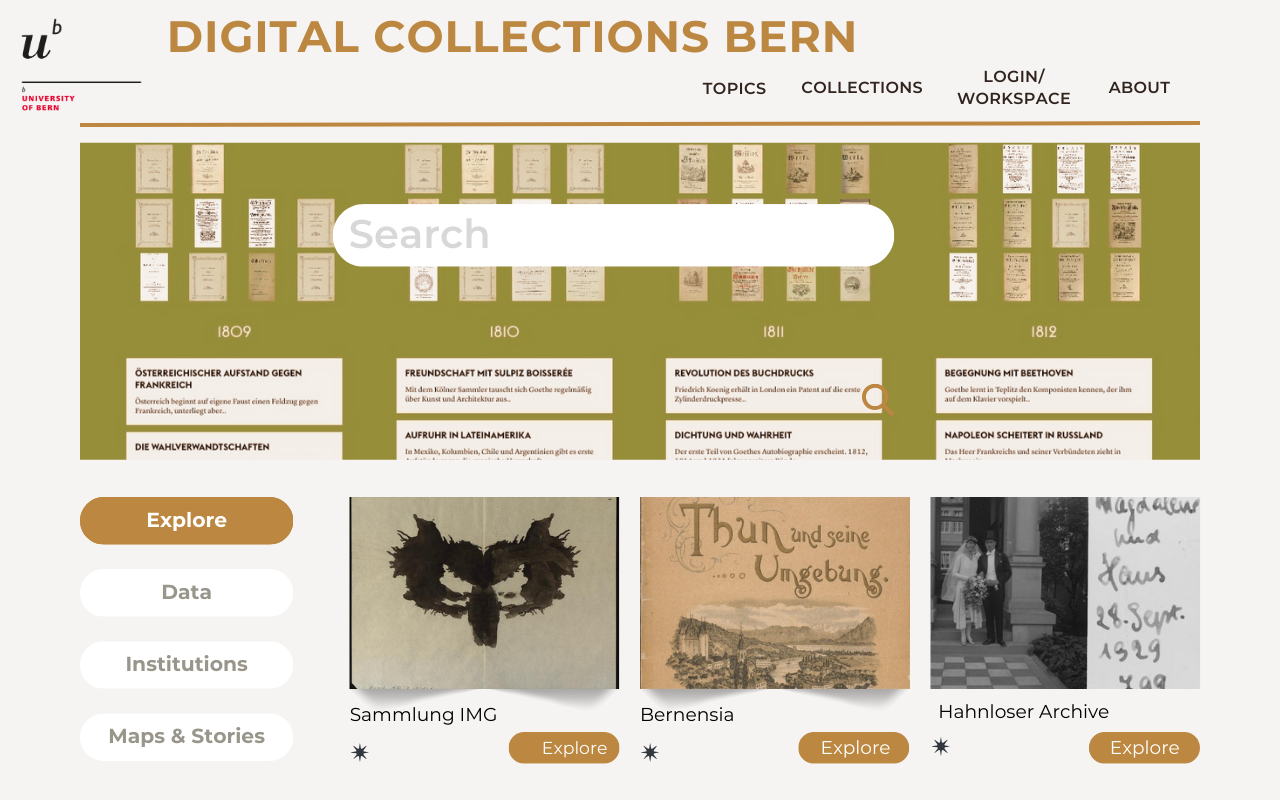
The University of Bern is home to a rich treasure trove of scholarly collections, historical documents, and cultural assets. Until now, many of these digitized holdings have had limited or no online access. The Digital Collections Bern (DCB) project aims to remedy this situation by developing a central platform for the digital presentation, utilization, and archiving of this diverse material—in a way that is research-oriented, sustainable, and publicly accessible.
Why digital collections?
Digital collections are a cornerstone of modern scholarship. They enable new forms of research, teaching, and public engagement. By transcending disciplinary, institutional, and national borders, they ensure both access and visibility, as well as the long-term preservation of our cultural heritage, making them vital for our increasingly digital knowledge society.
News
With the project structure defined and the necessary resources in place, it is now clear that the platform will be implemented by the end of 2027, covering procurement, development and rollout. A data protection assessment with recommendations for technical safeguards is also available.
At the end of 2025, the decision was made to use an instance of the Goobi software suite. This sets out three main priorities for 2026:
- Installation and configuration: The system’s core components will be installed and its architecture defined.
- Data preparation and migration: The collection data will be prepared for transfer to the new system.
- Collection concepts: Metadata schemas and workflows will be developed together with the collection owners, alongside the relevant legal and organisational foundations.
And last not least: We are happy, that intranda GmbH has been brought on board as project partner and technical sub-project lead.
Goals
With Digital Collections Bern, the University Library of Bern aims to create a efficient infrastructure for the digital collection, preparation, and presentation of scholarly and cultural content.
The project combines the library's various tasks: As the Cantonal Library, it makes digitized materials related to the Canton of Bern ("Bernensia") and other significant holdings available to the general public, including historical periodicals, monographs, and printed works. As the University Library, it supports research, teaching, and studies with research-oriented formats, structured metadata, rich indexing, and long-term preservation. The platform will thus become a cornerstone of the digital knowledge landscape for both the University of Bern and the Canton.
The first digitized materials, full-text data, and metadata are scheduled to be made available on the new platform starting in the first quarter of 2027, with full operations beginning in 2028.
Key features
Of particular interest are features that allow for the flexible post-processing of digitized materials—for instance, creating research-ready image formats, generating searchable texts via Optical Character Recognition (OCR), or building structured data sets through extraction and enrichment.
Key features also include:
- A centralized Platform: The DCB platform consolidates previously scattered digital collections, making them accessible through a single, unified interface.
- Diversity Content: From historical photographs and scholarly estates to born-digital publications, the platform is designed to accommodate a wide variety of media formats.
- For Research and the Public: Content is not only prepared for academic use but is also presented in an engaging way for the public through features like virtual exhibitions and crowdsourcing projects.
- Long-Term Archiving: The platform is integrated with the University of Bern's digital preservation archive, ensuring the permanent availability of its content.
- Digital Bernensia: Fulfilling its mandate as the Cantonal Library, the platform also provides access to "Digital Bernensia"—publications related to the Canton of Bern.
- Open Standards: The technical implementation is based on open formats and APIs (Application Programming Interfaces) to ensure interoperability and reusability.
Roadmap
The project is led by the University Library of Bern and is being implemented in close collaboration with university institutes, archives, and the library's IT department. It follows the HERMES 2022 project methodology and is divided into several phases:
- 2024–2025: Situational Analysis, Requirements Definition, Procurement, and Technical Concepts
- 2026: Platform Development and Migration of Initial Collections
- 2027: Expansion, Evaluation, and Transition to Regular Operations
Organization
The project is supported by an interdisciplinary team. In addition to various departments within the University Library (UB) and collection managers from university institutes, the team includes the University of Bern’s IT Services and other central administrative services.
Project Sponsor

- Name / Titel
- Marion Prudlo
- Funktion
- Vice Director, Head of digital services
- marion.prudlo@unibe.ch
- Phone
- +41 31 684 95 94
Project Manager

- Name / Titel
- Kathi Woitas
- Funktion
- Digital Scholarship Specialist
- kathi.woitas@unibe.ch
- Phone
- +41 31 684 92 02
Project Sponsor / Client / Sub-project Manager for Organization & Data

- Name / Titel
- Johannes Alisch
- Funktion
- Plattform Manager Digitale Collections Bern
- johannes.alisch@unibe.ch
- Phone
- +41 31 684 95 52
Project Committee
- Stefan Telli - University Library (UB), Head of IT
- Valentina Sebastiani - University Library (UB), Head of Central Library Services (ZHB)
- Prof. Dr. Tobias Hodel - University of Bern (UniBE), Faculty of Humanities, Digital Humanities; Member of DigiK; Management Board DSL
- Prof. Dr. Jens Dibbern - University of Bern (UniBE), Faculty of Business, Economics and Social Sciences, Institute of Information Systems; Member of DigiK
- Prof. Dr. Stefan Brönnimann - University of Bern (UniBE), Faculty of Science, Institute of Geography; Head of the Climatology Unit
Contact
Contact
- Name / Titel
- Marion Prudlo
- Funktion
- Vice Director, Head of digital services
- marion.prudlo@unibe.ch
- Phone
- +41 31 684 95 94
- Name / Titel
- Kathi Woitas
- Funktion
- Digital Scholarship Specialist
- kathi.woitas@unibe.ch
- Phone
- +41 31 684 92 02
- Name / Titel
- Johannes Alisch
- Funktion
- Plattform Manager Digitale Collections Bern
- johannes.alisch@unibe.ch
- Phone
- +41 31 684 95 52
Projektoffice
Digital Collections Bern
Hochschulstrasse 6
Raum 355
3012 Bern