
Researching with AI. Between Opportunity and Imposition

AI increasingly influences how we produce, assess and communicate research. Join us in an engaging workshop exploring uncertainties about the epistemological and methodological status of AI generated scholarly output.
This event is now fully booked out!
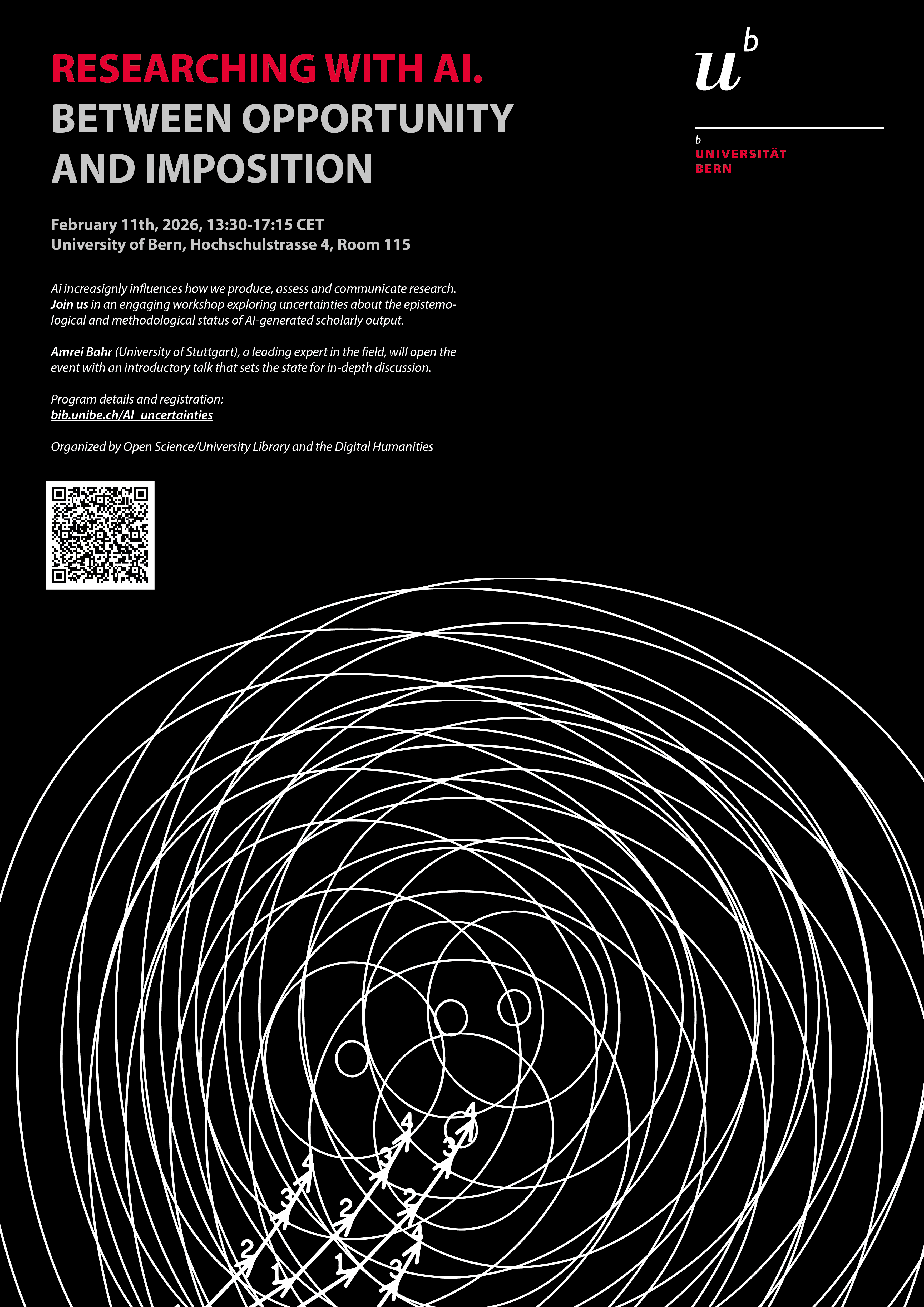
WHAT: Workshop at the University of Bern
WHEN: 11th of February, 2026, 13:30-17:15 CET
WHERE: Main Building, Hochschulstrasse 4, Room 120
Artificial intelligence promises to revolutionize scholarly and scientific inquiries. It influences how we produce, assess, and communicate our research. However, generative AI is not a neutral instance but built on previously digitized data, text, and imagery. Therefore, all generative AI systems are highly biased and a model of the past. Still, it is undeniable that the usage will allow us to create new forms of research.
The workshop combines theoretical approaches to open research data strategies with applied uses of various forms of artificial intelligence. By addressing AI as a methodological issue, we don't subscribe to the hype but rather put the various opportunities and limitations up for discussion.
Amrei Bahr (University of Stuttgart) is a renowned expert in the field and an important voice with regards to epistemological and methodological questions, when leveraging AI in the sciences. She will open the event with an introductory talk that sets the stage for the discussion.
The title of the talk is
Slop Till You Flop: Epistemological Risks of Using AI in Research
Abstract: Using AI appears to become more and more ubiquitous these days, research practices included: Large Language Models like ChatGPT, but also other AI tools are frequently used — not only for mundane chores such as formatting reference lists, but also for more conceptual tasks like developing and answering research questions. Given the warped incentives of academia such as ‚publish of perish‘ or the pressure to attract external funding, many researchers hope that AI will help them to regain control over their awfully long to do lists. However, using AI in research can cause several problems, not only from an ethical perspective, but also epistemically. The input will outline some of these problems and invite a discussion on urging questions that go along with them.
In the second part, we invite you to share concrete cases and examples in which you felt uncertain about how to use AI appropriately. These cases will form the basis for a joint reflection. In the final part, data stewards will comment on the raised uncertainties and provide their distinct perspectives.
This event is organized by Open Science/University Library and the Digital Humanities.
This event is part of the international Love Data Week 2026 #LoveData26
This event is held in English.